
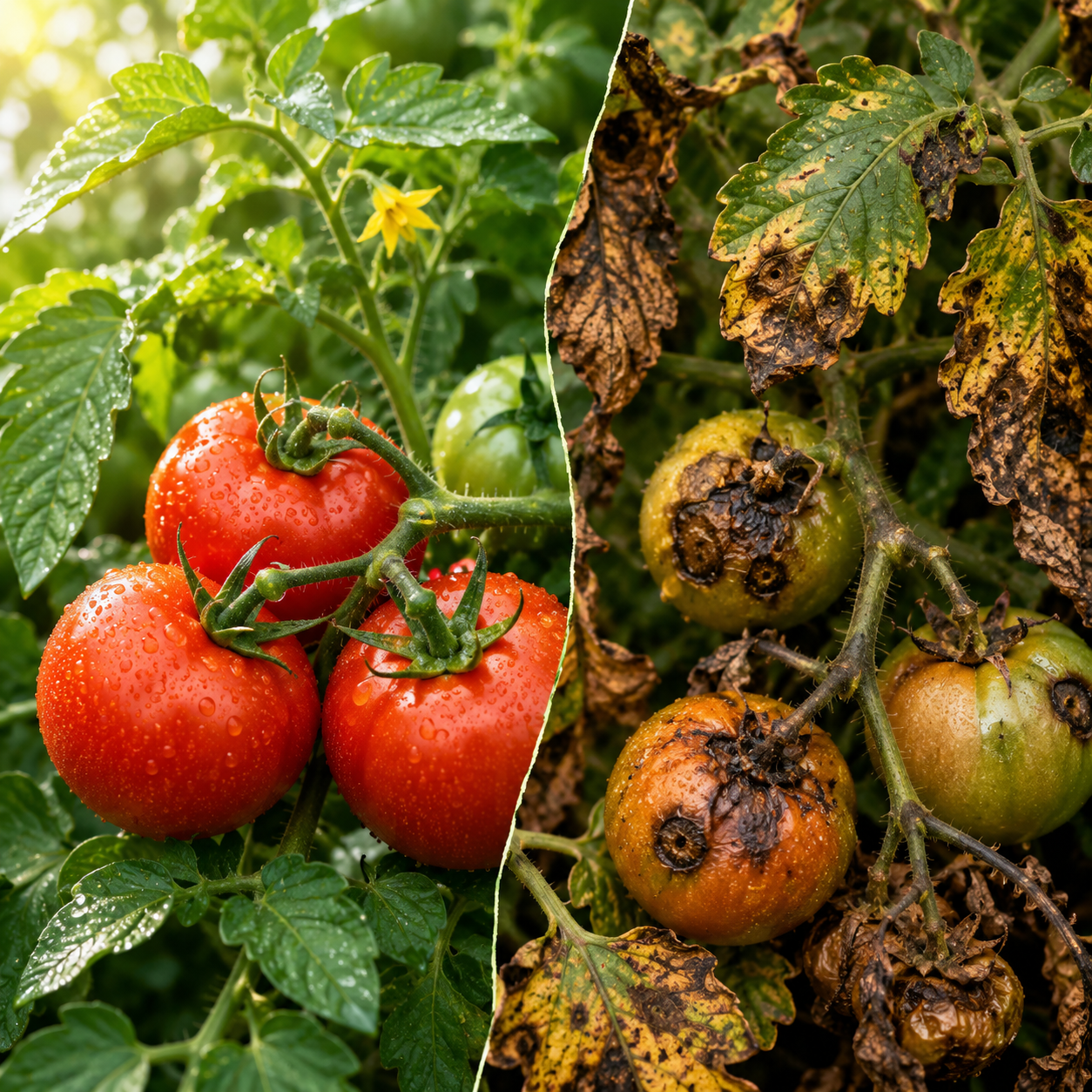
Tomatoes are among the most profitable vegetable crops in India, but they are also one of the most vulnerable during the monsoon. Continuous rainfall, high humidity, cloudy weather, and poor air circulation create ideal conditions for fungal and bacterial diseases that can destroy an entire crop in a matter of days.
The good news is that most of these diseases can be prevented. Farmers who combine good agronomic practices with biological crop protection and botanical formulations often experience healthier plants, reduced disease incidence, and better-quality fruits—all while reducing dependence on synthetic pesticides.
At Matihaat, we believe disease management begins with healthy soil, balanced nutrition, and preventive biological protection rather than waiting until infections become severe.
Why is the Monsoon Challenging for Tomato Cultivation?
Tomatoes prefer warm temperatures but dislike prolonged leaf wetness. During the rainy season:
- Relative humidity often exceeds 85%.
- Leaves remain wet for long periods.
- Rain splashes soil-borne pathogens onto foliage.
- Dense crop canopies reduce airflow.
- Warm temperatures accelerate fungal and bacterial growth.
- Insect populations increase, spreading bacterial diseases.
The result is rapid disease development unless preventive measures are taken.
Common Fungal Diseases of Tomatoes During the Rainy Season
1. Early Blight (Alternaria solani)
Symptoms
- Brown circular lesions with concentric rings.
- Yellowing of lower leaves.
- Premature leaf drop.
- Reduced fruit size and yield.
Favourable Conditions
- Warm temperatures (24–30°C).
- High humidity.
- Frequent rainfall.
2. Late Blight (Phytophthora infestans)
Perhaps the most feared tomato disease during prolonged rainy weather.
Symptoms
- Water-soaked lesions.
- Dark brown to black leaves.
- White fungal growth beneath infected leaves during humid mornings.
- Rapid collapse of entire plants.
3. Powdery Mildew
Unlike many fungi, powdery mildew does not require free water to infect plants.
Symptoms
- White powder-like coating.
- Curling leaves.
- Reduced photosynthesis.
- Poor fruit development.
4. Anthracnose
Usually attacks ripening fruits.
Symptoms
- Sunken black lesions.
- Soft fruit rot.
- Poor shelf life.
Common Bacterial Diseases in Tomatoes
Bacterial Spot (Xanthomonas spp.)
Symptoms include:
- Small water-soaked spots.
- Black lesions surrounded by yellow halos.
- Defoliation.
- Fruit blemishes.
Bacterial Speck (Pseudomonas syringae pv. tomato)
Common during cool, wet weather.
Symptoms include:
- Tiny black spots.
- Yellow margins.
- Reduced fruit quality.
Bacterial Wilt (Ralstonia solanacearum)
One of the most destructive soil-borne diseases.
Symptoms include:
- Sudden wilting.
- Green leaves that collapse without yellowing.
- Brown discoloration inside stems.
- Plant death.

Why Prevention is Better than Cure
Once fungal spores spread throughout the crop, control becomes difficult.
Organic farming focuses on:
- Preventing infection.
- Improving plant immunity.
- Supporting beneficial microorganisms.
- Reducing disease pressure naturally.
Best Organic Practices for Monsoon Tomato Farming
1. Grow on Raised Beds
Raised beds improve drainage and reduce root diseases.
2. Mulch the Soil
Use straw, dried leaves, or organic mulch to:
- Prevent soil splash.
- Conserve moisture.
- Reduce weeds.
- Improve soil biology.
3. Maintain Proper Plant Spacing
Good airflow allows foliage to dry quickly after rain.
Crowded plants remain wet longer, increasing disease pressure.
4. Prune Lower Leaves
Leaves touching the soil become the first point of infection.
Removing them reduces fungal spread dramatically.
5. Avoid Excess Nitrogen
Over-fertilized plants produce soft tissues that are highly susceptible to disease.
Balanced nutrition encourages stronger natural resistance.
Biological Disease Control: Working with Nature
Beneficial microbes suppress pathogens through competition, antibiosis, and induced plant resistance.
Common biological allies include:
Trichoderma harzianum
- Protects roots.
- Suppresses soil fungi.
- Promotes root growth.
Bacillus subtilis
Produces natural antimicrobial compounds.
Effective against:
- Early blight
- Powdery mildew
- Leaf spots
https://matihaat.com/products/koppert-vici-routz-sp
Pseudomonas fluorescens
- Colonizes roots.
- Competes with harmful microbes.
- Enhances plant immunity.
https://matihaat.com/collections/insecticides/products/t-stanes-biocure-b
Bacillus amyloliquefaciens
Produces natural antibiotics while stimulating plant growth.
https://matihaat.com/products/vici-routz-gr
Botanical Protection with Mati PlantOil
Plant-derived oils have long been used in sustainable agriculture to manage insects and reduce disease pressure.
Mati PlantOil is a botanical formulation developed from carefully selected plant oils that can be integrated into organic disease management programmes.
Its benefits include:
- Creating a protective layer on leaf surfaces.
- Helping suppress fungal spore germination.
- Reducing bacterial populations on foliage.
- Managing soft-bodied insect pests such as aphids, whiteflies, and thrips, which often spread bacterial diseases.
- Supporting residue-free farming practices.
Because botanical oils act through multiple natural mechanisms, they are valuable tools in resistance management and fit well within regenerative farming systems.
https://matihaat.com/products/mati-plant-oil-1-ltr
Biological Protection with Mati FungiGuard
Humidity is the biggest driver of fungal disease during the rainy season.
Mati FungiGuard is part of Matihaat's biological crop protection portfolio and is designed to help farmers manage fungal diseases using naturally derived biological approaches.
When used as a preventive spray programme, Mati FungiGuard helps:
- Reduce fungal disease pressure.
- Protect new foliage.
- Slow disease spread during prolonged humid weather.
- Support healthier plant growth.
- Reduce dependence on repeated synthetic fungicide applications.
Like all biological products, performance is best when applications begin before disease becomes severe.
https://matihaat.com/products/mati-fungi-gaurd-1-ltr
Suggested Organic Spray Programme During the Monsoon
| Crop Stage | Recommended Practice |
|---|---|
| Transplanting | Apply beneficial microbes around the root zone. |
| Vegetative growth | Improve airflow through pruning and staking. |
| Before rainfall | Spray Mati PlantOil as a preventive botanical treatment. |
| High humidity periods | Apply Mati FungiGuard according to label recommendations. |
| Entire crop cycle | Scout fields every 3–4 days and remove infected plant material promptly. |

Additional Organic Practices That Reduce Disease
- Rotate crops every season.
- Avoid planting tomatoes after potatoes or other solanaceous crops.
- Sterilise pruning tools.
- Remove infected fruits immediately.
- Irrigate early in the morning.
- Avoid overhead irrigation wherever possible.
- Encourage beneficial insects.
- Maintain healthy soil organic matter.
Early Warning Signs Every Farmer Should Watch For
Check your crop twice every week.
Look for:
- Brown circular leaf spots.
- Yellowing lower leaves.
- Water-soaked lesions.
- Black specks.
- White fungal growth.
- Fruit spots.
- Sudden wilting.
Early intervention prevents major crop losses.
Regenerative Farming Builds Stronger Plants
Plants grown in biologically active soils are naturally more resilient.
Healthy soils:
- Improve nutrient availability.
- Support beneficial microbes.
- Strengthen root systems.
- Enhance natural disease resistance.
This is why regenerative farming is not simply an alternative to chemical farming—it is a system that builds long-term resilience.
Final Thoughts
Tomato cultivation during the monsoon can be highly profitable when disease prevention becomes part of everyday farm management. Farmers who rely only on curative sprays often find themselves reacting after significant damage has already occurred.
Instead, success comes from combining good agronomic practices, balanced nutrition, healthy soils, beneficial microorganisms, and preventive botanical and biological crop protection.
At Matihaat, we work with farmers to build resilient cropping systems through regenerative agriculture. Products such as Mati PlantOil and Mati FungiGuard are designed to complement—not replace—good farming practices, helping growers reduce disease pressure while supporting healthier crops and more sustainable production.
Whether you cultivate tomatoes in a kitchen garden, polyhouse, or open field, prevention remains the most effective and economical strategy for managing fungal and bacterial diseases during the monsoon.
Frequently Asked Questions (FAQs)
What is the most common tomato disease during the monsoon?
Early blight and late blight are among the most common fungal diseases, while bacterial spot and bacterial wilt are widespread in humid regions.
Can fungal diseases be controlled organically?
Yes. Organic management combines resistant varieties, good field hygiene, crop rotation, beneficial microorganisms, botanical formulations, and preventive biological sprays.
How often should tomatoes be sprayed during the rainy season?
The interval depends on disease pressure and rainfall. During prolonged humid weather, preventive applications at label-recommended intervals are generally more effective than waiting for symptoms to appear.
Is Mati FungiGuard a replacement for good crop management?
No. Biological products perform best when integrated with proper spacing, pruning, sanitation, crop rotation, balanced nutrition, and healthy soil management.
Why is Mati PlantOil recommended before heavy rains?
Botanical oils help form a protective layer on foliage and can contribute to reducing fungal spore germination and populations of certain insect vectors, making them most effective when applied preventively before disease pressure builds.