
The Question We Keep Asking Wrong
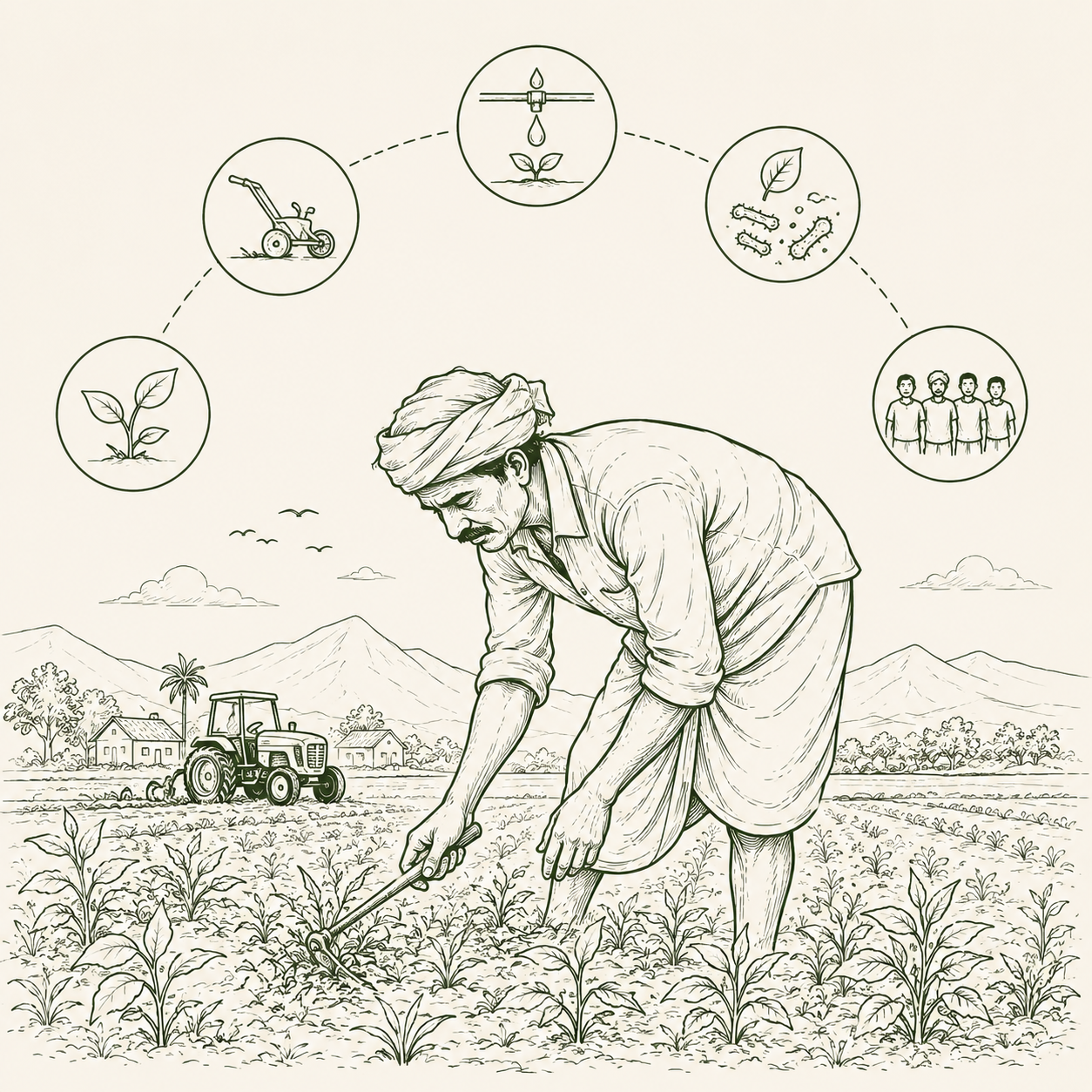
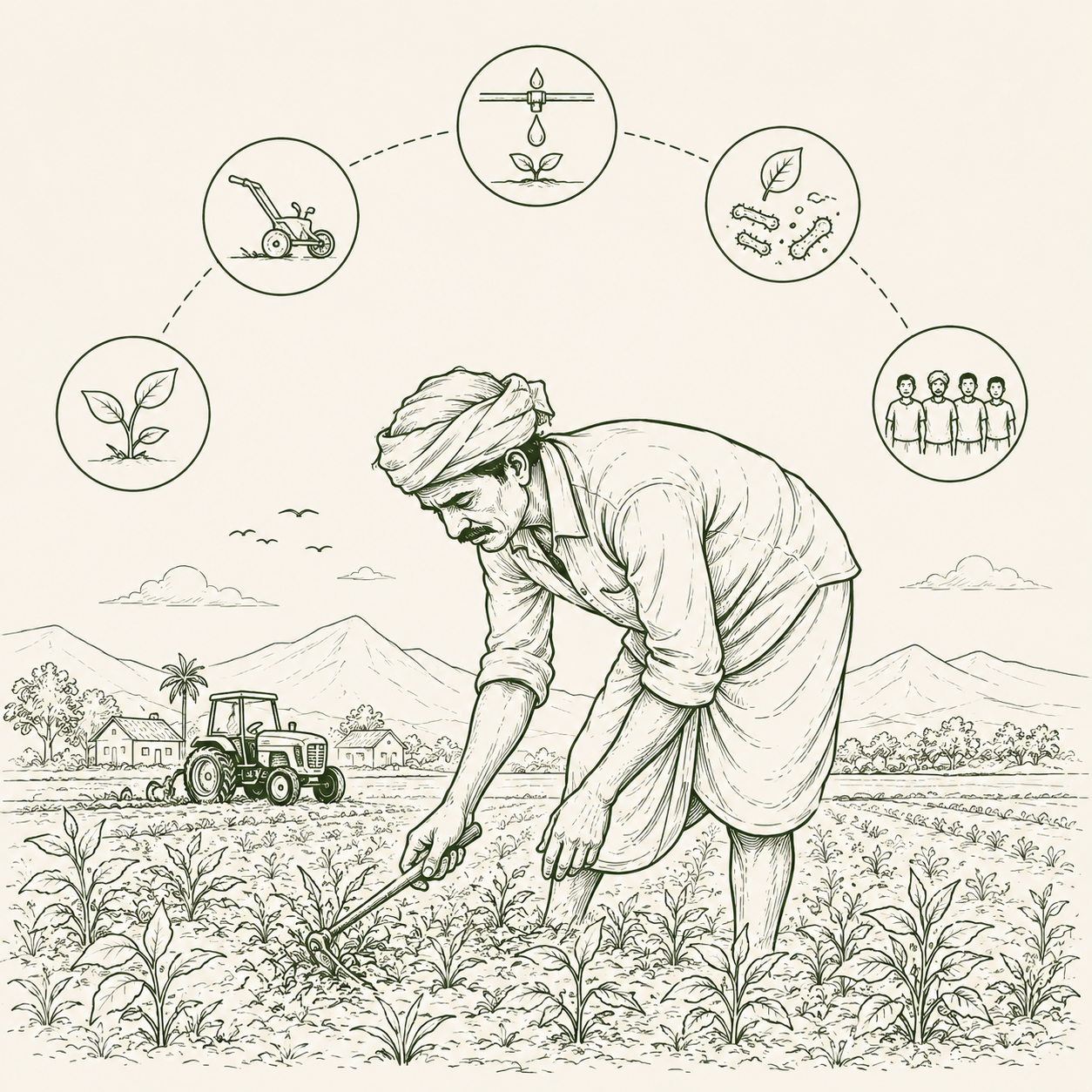
India keeps asking whether agriculture can become more regenerative, more climate-resilient, more food-secure. These are the wrong questions to ask first, because they all assume an infinitum of an input that is quietly disappearing: human hands that are willing to work in the field.
Regenerative agriculture, precision agriculture, biological farming, climate-resilient cropping, every one of these agendas is, in practice, a set of instructions for a farmer to follow. Apply this inoculant. Transplant on this date. Weed at this interval. Scout for this pest. Every instruction assumes that labour is available to execute it. When that assumption fails, the agenda fails with it, regardless of how sound the science is.
Labour is no longer one input among many in Indian agriculture. It is the binding constraint, the ceiling that determines what a farmer can actually do, independent of what the agronomy recommends, what the market wants, or what the climate requires. Until this is treated as the central design problem, every other reform will keep failing at the last mile: the three days a year when the crop actually needs someone in the field and no one is there.
The Economics Have Changed Forever
Twenty years ago, farmers complained about labour wages. Today they complain that there simply aren't any labourers to hire, at any wage.
That distinction is the whole story. A wage problem is cyclical, it moves with crop prices, with monsoon years and with local demand. A labour-availability problem is structural. It does not correct itself when prices rise, because the constraint isn't willingness to pay, it's the number of people left in the village willing to do the work at all.
India is going through the same transition every industrialising economy has gone through before it. Young rural workers are not staying to inherit their parents' relationship with agricultural labour. Construction sites, warehouses, delivery platforms and factories all offer steadier hours, better status and comparable or better pay than a day of transplanting or weeding under the sun. Agriculture has quietly become the employer of last resort in much of rural India: the work people do when nothing else is available, not work they choose.
This means labour scarcity during critical windows will keep declining even if wages double or triple. Paying more doesn't summon people who have left the workforce; it only bids up the price for a shrinking pool of people still willing to do the work. Any farming system, regenerative or conventional, that is designed around the assumption of abundant, on-demand manual labour is already obsolete. It worked in an India that no longer exists.
Peaks, Not Totals: The Metric Everyone Gets Wrong
Most discussions of agricultural labour default to a seasonal or annual labour-days number: how many person-days does a crop require across its life cycle. This is the wrong unit of measurement, because it hides the actual failure mode.
Farmers rarely fail because they couldn't find labour over an entire season. They fail because they couldn't find labour on three specific days. Rice transplanting. Cotton picking at the height of the flush. Tomato harvest during a two-week ripening window. Weeding immediately after a rain event, before weeds outcompete the crop. These are not steady labour requirements, they are spikes. A farmer may need twenty people for two days and almost no one for the following week.
This reframes the entire problem. It is a peak-demand problem, not an annual-labour problem, closer to how a power grid planner thinks about capacity than how an accountant thinks about a budget. The correct question for any innovation, whether it's a machine, a seed or a community institution, is not "does this reduce total labour-days over the season" but a sharper one:
Does this reduce the peak; the number of people needed on the single hardest day?
An innovation that shaves 10% off total seasonal labour but does nothing for the transplanting-week spike is nearly worthless to a farmer who cannot execute that week at all. An innovation that eliminates the spike entirely, even if it does little for the rest of the season, can be the difference between a crop that gets planted and one that doesn't.
Redefining "Labour Quantum Reduction"
Once the problem is framed this way, "mechanization" stops being a large enough answer. Machines are one lever for reducing labour quantum, a powerful one and the one most easily funded and subsidised but they are not the only one and often not the cheapest.
Biology, crop design, irrigation architecture, agronomy, variety selection and community organisation can each eliminate labour requirements as effectively as horsepower, frequently at a fraction of the capital cost. A useful discipline for any agricultural innovation programme — Mati Foods Llp included — is to run every proposed intervention through one question: how many hours of peak-season human labour does this permanently eliminate, without reducing productivity? Below are the levers that answer that question, grouped by mechanism rather than treated as a flat list.
Lever One: Mechanization — Still Necessary, Just No Longer Sufficient
Mechanization remains the most direct lever and land preparation is the operation where it has already delivered the largest dent in per-acre labour quantum for those who can access it. But two design constraints determine whether mechanization actually reaches the marginal farmer and both point away from the standard large-tractor model.
Tractors, sized and priced for the plot they'll actually serve. The conventional four-wheel agricultural tractor with geared transmission, differential, PTO shaft, hydraulic lift is engineered for a 40–60 HP workhorse doing 500-plus hours a year across a large holding. A marginal farmer needing perhaps 15–20 hours of tillage a season is buying far more machine, at far more cost, than the job requires.
Belt-driven tractors and power tillers, where power is transmitted from engine to wheels or rotavator through a belt-and-pulley system rather than a full gear-and-differential drivetrain, change that cost equation materially:
- Fewer precision-machined components — a belt-pulley drive avoids the differential, clutch assembly, and multi-speed gearbox that account for a large share of a conventional tractor's manufacturing cost and machining-tolerance burden.
- Local, low-tooling manufacture — belts and pulleys can be produced and serviced by small and medium manufacturers without the forging and gear-cutting capacity that geared transmissions demand, matching the decentralised machinery-manufacturing clusters India already has.
- Field repairability — a worn belt is a same-day fix at any local machinery shop; a damaged gearbox or differential usually means a dealer visit and days of downtime, which during a narrow sowing or harvest window is often more costly than the repair itself.
- Lower unit cost, viable ownership arithmetic — cheaper units make individual or small-group ownership work at 1–3 acre scale, and make custom-hiring fleets viable for machinery-service entrepreneurs serving fragmented landholdings.
The trade-off is real as belt-driven systems sacrifice some power-transmission efficiency and suit lighter tillage and haulage better than heavy-draft ploughing on hard soils but for the specific job of getting a marginal farmer's field prepared without a week-long wait for a borrowed tractor, "available, cheap to fix, good enough" beats "optimal but scarce and expensive." And trust me, every farmer knows how to change a belt. It is built into his DNA.
Implements, not just tractors. The conversation about agricultural mechanization for smallholders has been distorted by fixating on the tractor as the unit of analysis. A ₹8 lakh tractor is intimidating, structurally hard to finance, and often unnecessary for the job at hand. A ₹25,000 machine hoe is not. A ₹10,000 gasoline sprayer is not. A ₹5,000 seed drill is not. A small, well-designed implement targeted at a single labour-intensive operation like weeding, spraying, precision seeding, frequently eliminates more peak-season labour per rupee invested than another fifty horsepower would. Custom-hiring centres and FPO machinery banks built around a range of cheap, targeted implements, rather than a single expensive tractor, reach far more marginal farmers per rupee of scheme funding.
The China parallel: sequencing matters more than any single technology. China's own path through this exact problem is instructive because it moved through distinct models rather than mechanizing in one leap and the sequence is the lesson, not any single machine.
From the 1950s through the 1970s, China concentrated tractor ownership in state and commune-run tractor stations, following the Soviet model. This built manufacturing capacity and technical expertise at national scale but created a chronic mismatch between centrally allocated machinery and the localised, time-sensitive needs of individual plots, machines were routinely in the wrong place at the wrong time, the same complaint levelled against any over-centralised custom-hiring scheme.
From 1978, the Household Responsibility System returned land-use rights to individual households, and tractor ownership decentralised dramatically: the share of privately owned tractors rose from near zero in 1975 to more than 80 percent by 1985. Manufacturers responded to this new buyer by changing what they built, producing smaller, mechanically simpler, cheaper tractors suited to household-scale plots rather than the large state-station machines of the prior decades. Tellingly, as much as 60 percent of tractor use in this period went to local hauling rather than field operations. The small tractor's value came as much from its versatility (transport, milling, water-pumping) as from tillage alone, which is itself an argument for keeping unit cost and mechanical simplicity central rather than optimising narrowly for one operation.
Only in the third phase, from roughly 2004 onward, did a genuine machinery-service economy emerge. As rural wages rose and landholdings remained fragmented, individual ownership stopped being the most efficient model even for small, cheap tractors. Cooperatives, agribusiness firms and independent operators began renting out ploughing, sowing and harvesting machinery to smallholders who could never justify owning it outright. By 2021, professional agricultural machinery cooperatives in China were servicing close to 59,000 square kilometres of farmland, over half of the country's total mechanized grain-harvesting area. A service economy layered on top of a manufacturing base that had, decades earlier, been forced to get small, simple, and cheap.
The sequence is the transferable lesson: China did not jump straight to a rental-service economy. It first decentralised ownership and forced manufacturers toward smaller, cheaper machines suited to fragmented household plots. Only once that machine population existed at real density did custom-hiring and cooperative service models become viable, because there was enough distributed machinery for service providers to aggregate and route efficiently. An India strategy that tries to build machinery-rental infrastructure before there is a critical mass of cheap, simple machines in circulation is building the third phase without the first two and risks the same low-density failure that under-resourced custom-hiring schemes across the region already show.

Lever Two: Redesigning the Crop So It Needs Fewer Hands
A large share of Indian agriculture's labour intensity is not a fact of nature, it is a design choice made decades ago, when labour was abundant and cheap and then never again revisited. Several agronomic changes eliminate labour before it is ever needed, at a fraction of the capital cost of a machine.
Mulching. Biodegradable plastic mulch, straw mulch and living mulches all work the same way: they prevent weed germination rather than requiring someone to remove weeds after the fact. A properly mulched vegetable field can reduce weeding labour by 60–90 percent. No engine, no diesel, no machine purchase, just simply preventing the labour requirement from arising in the first place. This is the purest form of labour quantum reduction: labour eliminated, not merely done faster.
Direct seeding instead of transplanting. Rice transplanting remains one of India's single largest labour sinks, concentrated into an intense, narrow window that is exactly the kind of peak identified as the point of failure. Direct-seeded rice, supported by good seed treatment, precision spacing and careful moisture management, can eliminate almost the entire transplanting operation. The same substitution applies to a range of vegetable crops currently grown from manually transplanted nursery stock. What used to require thirty labourers on a single day can, with the right agronomic package and a seeding machine, only require two.
Crop geometry. This is rarely discussed but quietly determines whether any future mechanization is even possible. Most Indian fields were laid out around human labour with rows irregular, spacing changing metre to metre, plant populations uneven. That irregularity is precisely what prevents a wheel hoe, a battery weeder, a mini-tractor, or a harvest cart from ever entering the field, regardless of whether the farmer can afford one. Uniform spacing, decided once at planting, is a design decision that determines the labour profile of the next four months and every mechanization option available within them.
Variety selection. Short-duration varieties, uniform maturity, disease resistance and machine-friendly plant architecture (eg. determinate tomato varieties over indeterminate ones) all reduce labour by removing the need for repeated, staggered manual intervention. A large share of the labour Indian farmers spend is not driven by the crop's inherent needs but by uneven maturity. Multiple harvest passes where one would otherwise do, multiple spray rounds timed to an irregular pest or disease progression.
Village-level crop planning. This is a systems-level version of the same idea. When every farmer in a village plants tomatoes in the same week, harvest labour demand becomes a single, unmanageable village-wide spike and the exact peak-demand failure mode described earlier, replicated across every farm simultaneously. Staggering planting dates across a three-week window, coordinated at the FPO or village level, spreads that same total labour requirement across a period long enough for the available workforce to actually cover it. No input is purchased; the intervention is purely organisational.
Lever Three: Biology as a Labour-Reduction Technology
This is the lever most directly aligned with regenerative agriculture work and it deserves to be argued on economic grounds, not just ecological ones. For the purpose of this article, biological interventions are a labour-reduction technology first and an environmental good second.
Biological weed suppression. Healthy, nutritious and biologically active soils close canopy faster and suppress weed emergence through crop residue cover, allelopathic companion plants and improved nutrient cycling that favours the crop over competing weeds. Microbial inoculants that accelerate early crop vigour and canopy closure have a direct, measurable effect on weeding labour and every weed suppressed biologically is a labourer who never has to bend over a row.
Preventive biology in place of repeated spraying. Every pesticide application is a labour event: it requires labour to apply, water to carry, equipment to maintain and supervision to time correctly. A farming system built on preventive biology with healthy soil microbiomes, protective plant-derived compounds, beneficial-microbe populations that suppress disease before it establishes, reduces the number of spray rounds required across a season. Fewer rounds means fewer trips to the field, fewer labour-days and lower cash outlay on inputs simultaneously. This is an underused argument for regenerative practices in India: they are frequently the cheaper labour strategy, not merely the more sustainable one.
Living ground cover and intercropping. Cowpea, clover, sesbania and other living mulches contribute nitrogen fixation, but their labour case is at least as strong as their fertility case. They suppress weeds naturally, increase soil organic carbon, reduce evaporation and lower the frequency of irrigation cycles required. Each of those is a labour requirement that simply disappears rather than being executed more efficiently.
Precision nutrition. Balanced, well-timed nutrient management reduces lodging, disease pressure and the crop-failure and replanting events that create unplanned, unbudgeted labour spikes. A crop nutritionally managed well the first time avoids the second and third round of corrective intervention that poorly managed nutrition tends to generate.
Lever Four: Water and Irrigation Design
Poor irrigation design is a chronic, underappreciated source of labour demand. Flood irrigation requires channel repair, bund maintenance, active water management and continuous supervision, a recurring labour cost baked into the irrigation method itself, independent of the crop grown. Drip irrigation removes much of this; automated valves reduce it further; gravity-fed systems where topography allows reduce it again. The cheapest unit of labour is the one never created in the first place and irrigation redesign is one of the more capital-efficient ways to achieve that.
Lever Five: Community and Institutional Solutions
Not every solution requires a purchased input at all. Traditional reciprocal labour systems like neighbouring farmers harvesting together, rotating labour gangs, women's self-help groups pooling effort across member farms, had once existed widely across rural India and addressed exactly the peak-demand problem this piece has argued is the real constraint. FPO-organised work crews and village-level machinery operators serve the same function in a more institutionalised form: they convert an individual farmer's unmanageable, unpredictable hiring problem into a coordinated, shared resource that spreads risk and cost across many holdings. These solutions dramatically reduce hiring uncertainty on the specific days that matter most, often at lower cost and faster deployment than any capital investment.
The Unfortunate Truth
India often asks how its agriculture can become more regenerative. The more urgent question is whether Indian agriculture can remain viable at all if, every season, fewer people are willing to work in the fields.
Labour scarcity is not a temporary inconvenience to be waited out. It is the defining structural challenge of Indian farming for the next thirty years, and it will not reverse itself as incomes rise, but will deepen, the way it has in every economy that industrialised before India. Every policy, every innovation and every research programme in this space should therefore be judged against a single metric: how many hours of human labour does it permanently eliminate, without reducing productivity?
Sometimes the answer will be a tractor. Sometimes it will be a mulch sheet, a microbial inoculant, a better-designed seed, a redesigned field layout, a community hiring cooperative or a biological intervention that prevents three spray rounds instead of treating the fourth. The specific technology matters far less than the outcome it produces. What matters is discipline: refusing to adopt an intervention, however elegant, that does not measurably reduce the peak-day labour requirement a marginal farmer actually faces.
The future of Indian agriculture will not be built by replacing people with machines. It will be built by redesigning farming systems so that they simply require fewer human interventions to succeed, whether that redesign happens in an engine, a seed, a soil microbiome or a village calendar. Labour quantum reduction, not mechanization alone, must become the central organising principle of agricultural innovation in India.
If the country gets this right, marginal farmers will not merely survive the labour crisis; they will come out of it more productive, more profitable and more resilient than the system that preceded it. If it does not, no subsidy and no support price will compensate for fields that cannot be planted, weeded, or harvested simply because the labour to do it was never there.