
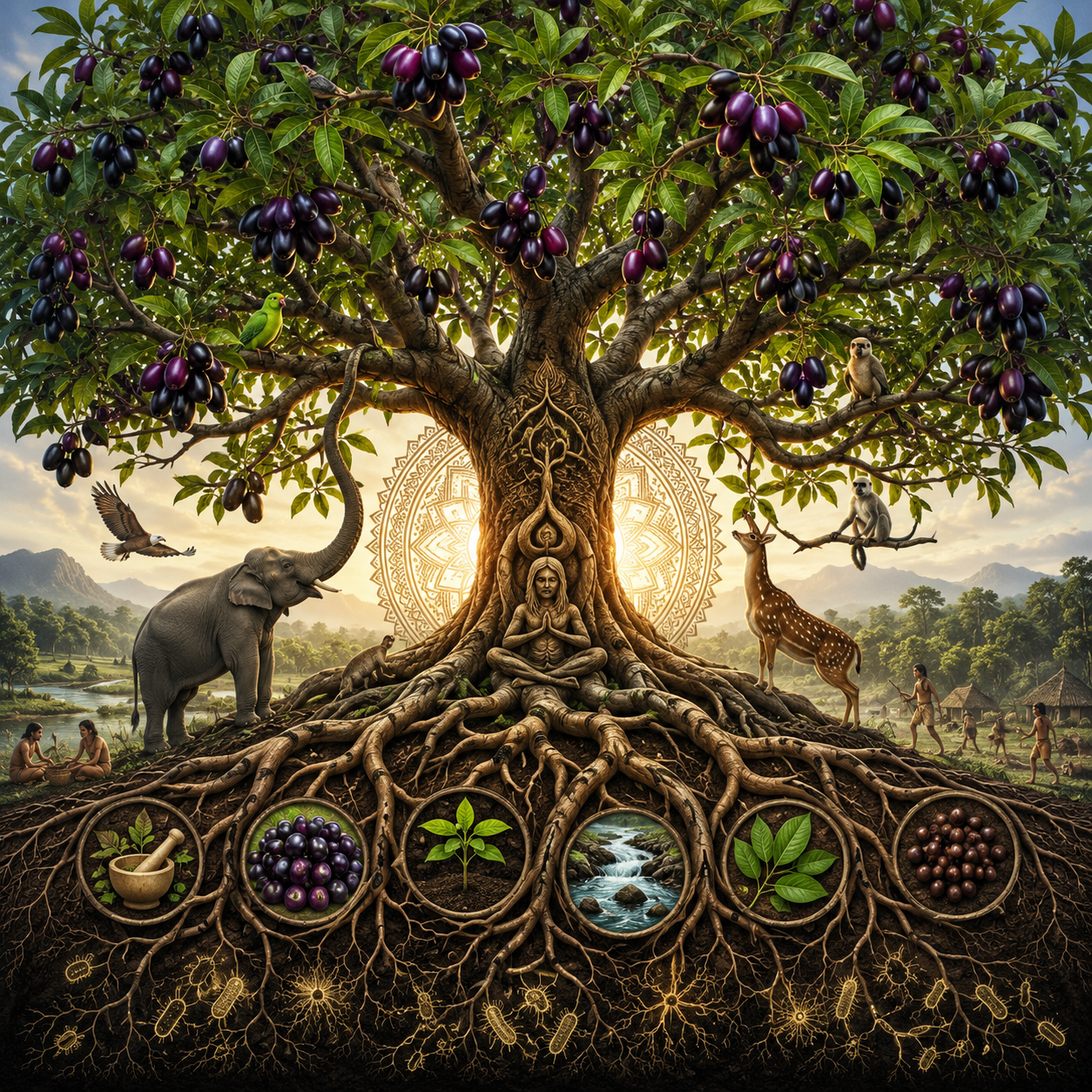
Long before India was called Bhārat, before foreign traders spoke of Indika, and long before maps divided the world into nations, this land was known by a name that honoured neither a king nor a kingdom.
It was named after a tree.
Jambudvīpa—the Island of the Jambu Tree.
At first glance, this seems almost improbable. Why would one of humanity's oldest civilizations choose to identify itself with a wild fruit tree?
The answer lies not merely in mythology, but in ecology.
For our ancestors, trees were not scenery. They were the architecture of life itself.
Every civilization has imagined a Tree of Life—a great organism standing at the centre of creation, binding together earth, water, sky and every living creature. The Norse spoke of Yggdrasil. The Mesopotamians carved sacred trees into stone. In India, however, the Tree of Life was never confined to mythology. It grew in forests, shaded villages, fed birds, nourished wildlife, healed the sick and sustained people through the rhythm of the monsoon.
Among these trees, one quietly became so important that it lent its name to an entire continent.
The Jamun (Syzygium cumini).
The Tree Before Civilization
Imagine the Indian subcontinent ten thousand years ago.
There were no cities.
No temples.
No kingdoms.
Only vast monsoon forests stretching from the Himalayas to the southern peninsula.
In those forests, the jamun stood as one of the great evergreen giants.
Every summer, just before the rains, it burst into fruit.
Its deep purple berries attracted birds by the thousands. Fruit bats carried its seeds across valleys. Monkeys feasted in its branches. Deer browsed beneath its shade. Bears, civets, elephants and countless smaller mammals consumed its fruit, dispersing seeds through forests that slowly expanded with every passing season.
Long before humans learned to cultivate crops, the jamun was already feeding ecosystems.
The tree became an engine of biodiversity.
Its dense canopy moderated the fierce tropical heat. Its roots stabilized riverbanks against monsoon floods. Fallen leaves enriched the soil with organic matter. Flowers provided nectar for bees, while cavities in aging trunks sheltered owls, parrots, squirrels and reptiles.
Entire food webs revolved around its annual fruiting.
In ecological terms, it was what scientists today call a keystone species—a single organism upon which disproportionately large numbers of other species depended.
Our ancestors did not possess this scientific vocabulary.
They simply knew that wherever the jamun flourished, life flourished.
The First Human Companion
Archaeobotanical evidence suggests that prehistoric communities across the subcontinent gathered jamun fruits long before settled agriculture became widespread. Excavations from Neolithic and Chalcolithic settlements reveal remains of Syzygium cumini alongside other wild foods that sustained early populations.
For hunter-gatherers, the tree offered an extraordinary combination of gifts.
Its fruits ripened precisely when many other food sources became scarce.
Its wood burned slowly and produced durable tools.
Its bark and leaves treated wounds and digestive disorders.
Its seeds, as later Ayurveda would recognize, possessed remarkable medicinal properties.
Unlike seasonal shrubs, a mature jamun tree could continue providing food for more than a century.
Generations of families could return to the same tree.
It became more than a resource.
It became a landmark.
A meeting place.
A memory.
Perhaps even an ancestor.
Why Ancient India Remembered a Tree
Most ancient civilizations named themselves after rivers.
The Nile gave birth to Egypt.
The Tigris and Euphrates defined Mesopotamia.
The Yellow River shaped China.
India chose differently.
Our oldest surviving civilizational name celebrated not flowing water, but the living organism that transformed water into life.
The Sanskrit word Jambudvīpa combines Jambu—the jamun tree—with Dvīpa, meaning island or continental landmass.
In later Purāṇic cosmology, Jambudvīpa became the central continent of the inhabited world, dominated by an immense celestial Jambu tree whose fruits were said to nourish creation itself.
To modern readers this sounds mythical.
To an ecologist, it sounds remarkably familiar.
A giant fruiting tree does not merely feed people.
It feeds forests.
It sustains pollinators.
It nourishes wildlife.
It stabilizes soils.
It enriches rivers.
It supports microbes beneath the ground while attracting birds above the canopy.
In every direction, life radiates outward from the tree.
This is exactly what a Tree of Life is meant to represent.
Science Meets Ancient Memory
Modern biology has only recently begun to appreciate what ancient cultures observed intuitively.
The jamun tree is one of the ecological powerhouses of tropical Asia.
Its fruits sustain hundreds of bird and mammal species.
Its flowers support pollinating insects during the hottest months of the year.
Its evergreen canopy provides refuge when deciduous forests stand bare.
Its deep root systems improve groundwater recharge while protecting watersheds.
Even after death, its timber continues serving human communities for decades.
Genomic research has revealed the remarkable diversity of medicinal compounds distributed throughout the fruit, bark, leaves and seeds—offering scientific explanations for medicinal traditions preserved in Ayurveda for over two millennia.
What our ancestors expressed through poetry, mythology and reverence, modern ecology increasingly explains through nutrient cycles, biodiversity networks and evolutionary biology.
Both describe the same reality.
Life gathers around certain trees.
The Tree That Became a Civilization
When Emperor Ashoka referred to his realm as Jambudvīpa in his rock edicts during the third century BCE, he was invoking a name already ancient.
It was a reminder that kingdoms rise and fall, but landscapes endure.
The identity of this civilization was rooted not in conquest but in ecology.
Not in stone monuments but in living forests.
Not in palaces but in perennial trees that had sustained humans, animals and countless unseen organisms for thousands of years.
Perhaps that is why the name has endured with such quiet power.
The oldest surviving name for India does not celebrate an emperor.
It celebrates a living species.
A tree that fed prehistoric communities, sheltered wildlife, stabilized rivers, healed the sick, inspired philosophers and eventually gave an entire civilization its name.
In an age when forests are disappearing faster than they can regenerate, the story of Jambudvīpa reminds us that our ancestors understood something we are only beginning to rediscover:
A civilization is only as enduring as the trees that sustain it.